Saturday, November 7, 2009


8. 

THE LAKE IN THE CHEST

Aidai, the Kochkor CBT coordinator, in a matter of hours arranged a three-day horse trek for 
me to Köl Ukok, the Lake in the Chest, leaving at nine the next morning. That was easy.

Showered and well fed I lay in bed listening to the azan. It was the first time I had heard the Muslim call to prayer since I arrived in Kyrgyzstan.

Most Kyrgyz identify themselves as Muslim, but they don’t strictly adhere to the religion’s five pillars. Gulbaira covered her head, but I never saw her or Assambek pray. They will observe Ramadan, which begins September 1st, meaning that they will get up at four in the morning to eat and then do all those chores with no more food until sunset.

Invading Arab armies brought Islam to Central Asia in the 8th century, but it didn’t become the official religion of what is now Kyrgyzstan until the 10th century.    Shamanism, the indigenous religion, continued to be a potent force; Allah was another god in its pantheon. The Kyrgyz adopted some Muslim rituals like circumcision and celebrating the first anniversary of a person’s death, but weddings and funerals proceeded whether there was a mullah there or not and women didn’t veil.

Islam grew more influential in the early 19th century during the rule of the Khanate of Khokand, particularly in the Fergana Valley in the south where there were large numbers of ethnic Uzbeks who were historically more devout. Its influence peaked in the 1920s, just in time for the Communists and their anti-religious policies to drive it underground.

Glasnost allowed Islam to come out of hiding in Kyrgyzstan and the other Central Asian republics, and since the collapse of the Soviet Union it has flourished once again, but nomads like the Kyrgyz have always worn their religion lightly.  

✢

In the morning I was on my own again. Leaving Kristin, Alina, and my big suitcase behind, I went out to meet a horse.

Two horses were tied to a street sign in front of the CBT office. Tending to them was Cholponbek, or Chopo for short, my guide, a tallish, thin young guy in jeans, a blue windbreaker and slip-on, black, pointy-toed dress shoes.

It was the height of the tourist season and all the English-speaking guides were out with other tourists. We ran through Chopo’s repertoire of English phrases before we were out of Kochkor.  “What is your name?” How old are you?” “I am twenty-one. I have two sisters and one brother.” “My hobby is volleyball. What is your hobby?” The trip could be a quiet one. 

Chopo had a casual riding style. He’d slide his weight to one side of the saddle looking like he was going to slide right out of it, and then slide over to the other side. Sometimes he rotated his hips so that his upper body was facing sideways rather than straight ahead. And his horse pooped all the time. I don’t know if it had a problem or was trying to make me envious.

We followed Kochkorskaya Road out of town towards the mountains, passing white-washed houses with light blue trim that were right out of a fairy tale. The wood trim around the windows and along the eaves was cut into patterns of triangles and half circles. In-laid tiles and mirrors or bas-reliefs of traditional Kyrgyz designs, even the hammer and sickle, decorated the sides of some houses. The roofs were hipped or gabled using wood or corrugated steel. For the gables long, narrow slats of wood were arrayed vertically, horizontally and diagonally. Blue and white picket fences enclosed gardens in which grew sunflowers, dahlias, marigolds, cosmos, and apple trees heavy with fruit.

As we got further out of town the houses were set further apart and had been left the natural plaster color, but the trim was still painted light blue. Some had flats roofs and exposed wooden beams reminiscent of the pueblo style popular back home. And then I saw it: hollyhocks against an adobe wall, the clichéd postcard image of New Mexico. 

Leaving the road behind, we headed across wheat fields crisscrossed by gushing ariks. The water had been diverted from the Shamen River whose valley we would ascend to reach Köl Ukok.

The lake is described as alpine, but as the trail climbed up into the mountains, I saw nothing that brought the Alps to mind. The ground was sandy and rocky, dotted with tufts of coarse grass and bushes with sharp leaves and gnarled branches. The only trees were the ones that lined the banks of the river well below us.

The lake can only be reached by horse or on foot, there are no roads, and I felt very far from civilization; only momentarily it turned out, for around a bend appeared another guide returning from the lake with his sole charge and talking on his cell phone.

The trail led us higher and higher; the grass becoming thicker, more carpet-like. Herds of cows and sheep grazed on the green slopes. Flowers appeared. Purple was the most popular color: pale purple asters; clusters of bell-shaped, violet flowers; delicate purple-petaled flowers laced with darker purple veins; fat thistles. A variety of dandelion on a long, thin stem with a cluster of flowers at the top added touches of yellow to the scene. Now it was like the Alps.

We had been riding for almost six hours. I realized too late that my stirrups were too short and my knees were throbbing. We arrived at a rocky hill, the rocks covered with rust colored lichen; on the other side was the lake. The path among the rocks was no more than a few inches wide. I hoped Sherdar, my horse, who had occasionally stumbled during our ascent, wouldn’t stumble now.

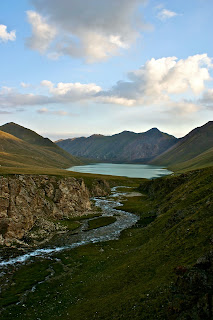
From the top of the hill, the turquoise lake spread out before us, much larger than I expected. The near end of the valley was narrow, its sides rising steeply, the path just hanging on. It widened as we approached the far shore where a few yurt camps were set up, their chimneys gaily pumping out grey smoke against the cold. The temperature had dropped dramatically and the sky had issued a threat or two of rain or snow, but hadn’t yet followed through.

Chopo pointed to a yurt far from the lake as the one where we were going to stay. I felt a pang of disappointment; I had come to see the sunrise over the lake. “Try to be like the Central Asians, Liz, just roll with it,” I encouraged myself. “I will find something wonderful about the location.” And in the morning I did. Looking out from the high banks of the shallow river that ran by our yurt to the lake in the near distance was more beautiful than the lake itself.

Altanbek, Kenje, their son Zulkar, twelve, and daughter Nursia, nine, were our hosts. Their camp consisted of a yurt and a canvas tent where the cooking was done and where the family slept when they had guests.

In a week or two they would be leaving this jailoo for one farther down the mountain, and then in October, they would return to their village for the winter.

Yurt is the Turkic word for “dwelling” or “home.” It was the Russians who applied the term specifically to the portable domed structure of the steppe nomads.

In Kyrgyz it is called boz üy meaning “grey house” taken from the color of the felt. So entwined is it with national identity that the tunduk, the wooden circle with six crossed poles that frames the yurt’s smoke hole, is the emblem of the Kyrgyz flag.

The yurt is designed for mobility and easy set up and dismantling. Poplar poles called kanats are bent and attached with leather nails or straps to the kerege, a circular concertina framework of wood. Chiy, woven reed mats, are used to line the kerege, and the exterior of the whole structure is covered with heavy felt rugs held in place by ropes tied to stakes in the ground.

The er jak (left side) is the man’s side of the yurt, where all horse tack and hunting gear is stored. The epche jak (right side) is the woman’s, where the stove and kitchen equipment are set up. Nowadays, many families have separate tents for the kitchen. The juk is opposite the door and all bedding and carpets are kept there, usually stacked atop a brightly decorated chest.

If the family has money, the interior may be decorated with beautiful and colorful appliquéd felt rugs called shyrdaks and with long, narrow, weavings hanging down from the tunduk and tied to the kanats.

Altanbek and Kenge’s yurt was not a deluxe model.


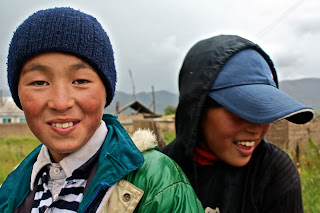
photos: (1) Köl Ukok, (2) A view from the yurt, (3) Zulkar and friend

Wednesday, November 4, 2009

7. 

GOLDEN GIRL OF THE JAILOO

part 2

Another delay. Would our ride ever happen? Dyadushka had to bring the sheep in and needed the horse. As he neared the wagon, I walked down to meet him. My route took me by the stacked dung bricks used as fuel. The smell was overpowering, but not nearly as awful as the smell of the sheep themselves. God, those animals stink! Their fleece was shaggy, clumpy, matted and muddy. To encourage and direct them, Dyadushka, who rode in a pinstriped suit coat, a homburg and soft-soled leather boots slid into plastic sandals, rattled a plastic water bottle with pebbles in it.

With the sheep moved, Kristin and I could finally have our ride. Except that our dreams of each mounting a horse and racing up and down the jailoo together were thwarted by there being only one horse. We had to settle for taking a turn riding the horse up and down a path that skirted the edge of the hills behind the wagon. The Jainakovs had dozens of horses, but it seemed that only one was gentled. A second horse was promised for the next day (it never materialized). 

Having sat around all morning and a good part of the afternoon, I decided to take a hike up into the hills. After walking about twenty minutes I came upon another wagon. The two children sitting out in front waved for me to come over. I was invited inside where I discovered the mother and an older daughter making borsok. There were already large pancakes of dough rolled out and set aside on a sheet on the floor. Unlike the Jainakovs’ wagon, their wagon had a stove set up inside and it was cozy and warm. The sun filtering in through a small window behind the stove mixed with the smoke to cast about a hazy light. Children’s clothes hung from a rope tied between two roof supports. Tacked to one wall was a plastic cloth decorated with bananas, mangos, papayas and melons.

The stove was no more than a metal cylinder with two doors near the bottom. The lower was for removing the ashes and the upper for feeding in the dung fuel. Set into the opening at the top was a kazan filled with hot oil.

Bending over a low table, the mother and daughter re-rolled the dough and sliced it into small squares. Each pancake yielded about twenty-eight borsok and there were at least ten pancakes. The squares were dumped into the hot oil for no more than thirty seconds. Right out of the kazan borsok is very tasty, soft and warm; several days later it’s better with butter and jam.

✢

Assambek had nine children. Gulbaira was his second wife, and not much older than his oldest child. His first wife had died of a misdiagnosed illness six or seven years ago. He had met Gulbaira, who lived in another village near Döng Alysh, through mutual friends and they had been married five years.

“At first,” Gulbaira said, “his children wanted nothing to do with me. I was not their mother. But little by little, they have come to accept me.” It was obvious that Elmira loved Gulbaira very much. 

Gulbaira had been widowed at forty. She had married her first husband when she was eighteen. Their first child, a girl, died very young. Their second child, a boy, died in infancy. And their third child, another son, was tragically drowned in Issyk Köl when he was eighteen. Her husband died of grief a few months later.

“I am very happy with Assambek. He treats me very well,” Gulbaira said, and patted her husband’s hand.

It had been a long day and we were all tired and ready for bed. Kristin, Alina, and I were to sleep in the eating room. The table was pushed to one end and our beds were laid out for us: first sheepskins, then floral cotton mattresses, and then quilts and pillows.

The light bulb in the larger room had burned out so Dyadushka sat on a low stool holding a pen light that gave a penny’s worth of light for Babushka and Elmira to lay out their bedding by.

 ✢

“Let’s go ride a horse,” Alina said to me. She actually just meant me. Alina gave lie to the idea that all Kyrgyz are horse people. She didn’t really like to ride and was a bit afraid of horses. She didn’t like dogs much either. To be honest, there wasn’t much to like about the Jainakovs’ dogs; they snarled and barked at everyone and everything.

Swinging myself into the saddle, I announced to Alina and Elmira that I was going to take the horse over the creek and run it across the meadows. No sooner had I crossed the creek than Alina called out to me.

“Babushka wants you to move those cows.” She pointed to a group of five or six cows grazing near the Jainakovs’ horses. “They’re not theirs and need to be moved farther to the right.”

“But I’ve never herded cows before!” I shouted.

“Try, if you can.”

Why not?  If I messed up Elmira could fix it.

In Moscow, desperate to find traveling companions, Ella had lied about her ability, saying she was an experienced rider who could last twelve hours in the saddle if need be when, in truth, her total equestrian experience was thirty minutes. Just days before heading up into the mountains on her two-month trek, her attempt to leap into a saddle ended up with her doing, as she called it, “a slow motion dive” and finding herself lying on the ground. I had a bit more experience than that.

Off I went, encouraging the horse to run with “Cha! Cha! Cha!” and slapping its rump with the whip. The cows didn’t demonstrate the herd mentality I was hoping for. Instead of grouping together as the horse and I circled them, they scattered, not far, but far enough that I had to be constantly maneuvering them back together and in the direction I wanted them to go. I’d get one going and move onto the next, only to have the first cow stop and start munching. Slowly but surely, though, I got those obstinate, trespassing ruminates on their way. I followed them until I saw, sitting on top of a hill, a very large, very tough looking black bull. The cows could make it home on their own.

My job complete, I slapped the horse to a gallop. We flew across the jailoo, scattering sheep and goats, the vast, cloudless, blue sky over our heads, I losing my hat. I thought I could be a cowgirl for a while. When I pulled the horse to a stop at the wagon, Babushka and Alina were waiting for me. Babushka clapped her hands and exclaimed, “Fine job! Stay. I will find you a Kyrgyz husband.”

 ✢

A farewell meal of delicious steaming bowls of borscht, and of course, some farewell shots of vodka. Dyadushka and Babushka each made a toast and each shot was followed by what I hoped was a once in a lifetime experience: goat fat chasers. No taste, just soft, squishy texture. Yuck!

After two bowls of borscht and two shots of vodka I was ready for a nap. No such luck. Nurbek’s car couldn’t make it up the dirt track to the wagon; we would have to meet him by the river.

“Please,” Babushka said to me as we got ready to leave, “publish your photographs of 

Kyrgyzstan in a magazine or newspaper. Tell everybody about our country.” The Kyrgyz people are very proud of their culture and country.

“I would love to publish them, but unfortunately that’s not my decision to make.”  

After taking some group photos, including some neighbors who had come to check out the foreigners, and heartfelt thank yous to our hosts, we set out with Dyadushka leading the way on horseback. For two kilometers I dragged my suitcase, which had suddenly become so heavy I thought Babushka had hidden herself inside, over grass, mud, stones, carried it over puddles, and then across a creek on a six-inch wide plank.

 ✢

Nurbek and Aisulu drove us to the school in Döng Alysh where we were supposed to meet teachers and volunteers who had participated in the United Nations Population Fund’s (UNFPA) Stronger Voices program. Interviewing the participants was the main reason Kristin had come to the village. We had been assured before going to the jailoo that they would be at the school that afternoon, but when we arrived the only person there was the curator of a funny zoological museum located on the second floor of the school. The teachers and volunteers were “on the jailoo.”

Kristin was convinced that Aisulu, who was to have made the arrangements, hadn’t done anything about it. Aizhan, the former principal of the school, had arranged our stay with Aisulu, her best friend. She had moved to Karakol the day after we arrived in Döng Alysh, and Kristin said, and she was probably right considering what happened on the ride back to Kochkor, that once Aizhon was gone, Aisulu felt no obligation to fulfill her friend’s promises.

Hookan Kokobaev was the son of a revered Soviet era biologist, pedagogue and founder of the school, Nukan Kokobaev. Nukan died in the early 1970s, a hero of another age, but his image was everywhere, from a memorial stele at the school’s entrance to a large portrait hanging in a stairwell. The first room of the museum was filled with his diplomas, awards and commemorations; photographs of him with politician and students; even one of his suits was on display in a glass case.

Three poorly lit rooms housed the museum’s collection of scary stuffed goats, sheep, birds, badgers, foxes, wolves and other wildlife indigenous to Kyrgyzstan. There were even a lamb with two heads and one with six legs. What made them so scary were the eyes. In place of glass eyes, which were probably too expensive, eyes had been painted on pieces of orange-ish leather and sewn into the sockets.

The habitats looked like 5th grade art projects and many of the animals had seen better days, yet the pride that Kokobaev the Younger and the villagers took in the museum was touching. It was the only museum of its kind in the area we were told, and children from all over the Kochkor region came there on school trips.

The midwife that Kristin had hoped to talk to had also mysteriously disappeared onto the jailoo. We headed back to Kochkor.

Raised voices speaking in Kyrgyz in the backseat.

“Aisulu wants 1500 som for the ride to Kochkor,” Alina told Kristin.

Kristin balked. “She can’t be serious. We can’t pay that much. I have very little money left.”

Aisulu said something to Alina, who then turned to Kristin. “She says that’s what the taxis charge.”

“That’s three times what we were charged to get here.”

Aisulu repeated the price of 1500 som.

“We just took a taxi here three days ago. I think I can remember how much we paid.” Aisulu didn’t need Alina’s translation to understand that Kristin was not happy. She

was off and running, with Alina trying to keep up.

“You stayed two nights with Dyadushka. Did you pay him for that? Did you give him money for food? Did you?”

“Of course. We gave him the same per day as we gave you.”    

Nurbek didn’t involve himself in the negotiations, trusting Aisulu to look out for their interests. I was glad I was in the front seat and didn’t have to involve myself either. Upon hearing that we had paid Dyadushka, a fair price was suddenly offered and a fragile peace restored. 


Photos: (1) Making borsak, (2) Alina at a comfortable distance from the horses, (3) Checking out the foreigners, (4) Scary stuff

Tuesday, November 3, 2009


7. 

GOLDEN GIRL OF THE JAILOO 


A loud crack of thunder. Our hoped for horse ride would have to wait. Kristin and I were anxious to ride, but all afternoon one thing after another had interfered with our plans.

First we had to observe the ritual welcoming of guests to a Kyrgyz home, namely drinking tea. We seated ourselves on cushions around the low table in one of the two rooms of the wagon where the Jainakovs live in the summer as Gulbaira and Elmira, their thirteen-year-old grand daughter, laid out food.

The Kyrgyz practice pastoral nomadism moving between low elevation, winter grazing lands called kyshtoo, and mountain, summer pastures called jailoo.

Nomadism is shrouded in romantic notions of free spiritedness and rootlessness. Ella writes, “The nomad’s life enthrall me. Its restlessness pursues me: it is as much a part of me as of the sailor. All ports and none are home to him, and all arrivings only a new setting forth.” But Kyrgyz nomads aren’t sailors and they aren’t vagabonds. Their society is strict and tradition bound, and their movements are rarely arbitrary. The Kyrgyz didn’t roam from place to place, settling in a spot for a while then abandoning it on a whim. They moved in aul (family groups) between lands that were recognized as belonging to them.

The Russians arrived in the mid 19th century, bringing with them railways, cities, and settlers, which had a devastating effect on the nomadic way of life, much like the effect American westward expansion had on the Native Americans.

Thousands of Slavic and German farmers arrived to establish farms on “unclaimed land” preventing the Kyrgyz from following their herds. By the late 1880s, thirty thousand settlers had arrived in present-day Kyrgyzstan.

Soviet rule was even worse. Stalin’s policy of collectivization (1928-1932) rounded up farmers and herders onto kolkhazi (collective farms). All livestock had to be turned over to the state, the nomadic lifestyle gone. In a destructive and heartbreaking act of resistance Kyrgyz, and Kazakh, herders slaughtered their sheep and horses by the millions. Many Kyrgyz fled to China, which in retrospect wasn’t such a good move.

Since independence some of the old ways have returned.

The traditional jailoo dwelling is the yurt. Having a wagon, though, is considered a step up the economic ladder by the Kyrgyz, but not nearly as exotic to us westerners. The Jainakovs’ wagon was silver with blue trim and made me think of a gypsy caravan. Inside, there was a room for eating and one for sleeping. And like in a yurt, there was little furniture; in the eating room there was the table and a buffet where dishes, glasses, and the vodka were kept. Items like family photos, paper and pens were stored in plastic bags hanging from nails on the walls. In the other, bigger, room was a unit of shelves for cooking pots and teakettles. In the front right corner were the stacks of bedding, pulled out every night and put away every morning.

The Jainakovs had a small, red, Chinese generator powered by a small solar panel. The generator, in turn, powered two fluorescent lights in the wagon and a stereo that was built into the generator itself. A canvas tent that served as the kitchen and storeroom was pitched next to the wagon. There was a sheep enclosure a several yards in front of the wagon and junk, turkeys and chickens lived under the wagon.

By local standards, the Jainakovs were well off, with their wagon, their generator, their hundred plus sheep, cattle and horses and eighteen foals.

The views were spectacular, wide-open grassland giving way to majestic snow-capped mountains in all directions. There was a narrow creek running just below the sheep pen and the grass growing near it was lush and the ground soggy. As the land rose behind the wagon tufts of long, tough grass punctuated the short, coarse grass. The sky was endless.

We ate and waited for the water to boil in the samovar that was set up outside. A stovepipe had been attached to the top and Gulbaira shoved sheep dung through a door at the base of the pipe and lit it. When the water was ready, she filled two thermoses with the boiling water. At the table, she poured a little hot water into a teapot containing loose tealeaves to brew very strong tea. She then poured small amounts of the brew into handle-less cups; a tiny strainer attached to the end of the spout caught any escaping leaves. Finally, she added boiling water to each cup and passed them around. The tea must then be sweetened to the taste of each drinker, and if you are Kyrgyz that means adding sometimes as many as five sugar cubes, or jam, or smetana, or all of the above if you are Alina.

After enjoying a cup or two of tea, out came the shot glasses and a bottle of vodka.* Only two shots were required today. Before the first shot, our host made a toast of welcome. For the second shot, Kristin or I was asked to make the toast. Kristin succumbed to a bout of shyness, so the task fell to me. I acquitted myself most admirably, considering that speaking off the cuff is not one of my strengths.

“Thank you for your hospitality. You have a beautiful country and a beautiful jailoo. We are very happy and honored to be here.”

Having dispensed with the welcoming ritual, we were sure that it was time for our ride. But no, the mares had to be milked, one of four milkings a day. It is a chore that requires strong legs and good balance. As a mare is taller than a cow and her udders don’t hang very low, stools are worthless. Gulbaira had to go down on one knee, holding the bucket on the other, as she milked. Raw mares’ milk, called saalmal, is whiter than white and has forty percent more lactose than cow’s milk. To make kymyz from saalmal, pour the milk into a wooden or plastic vat and add yeast. Using a paddle, called a pishpek, stir or churn the liquid. Fermentation can occur in as little as a few hours. In the past, saalmal was placed in horse-hide containers and strapped to saddles, the motion of the horses doing the work. 

After milking the mares, Gulbaira had to milk the cows, and separate the milk with a manual separator.

To separate milk, she heated it up in a kazan, a large cast iron cauldron that is the most important piece of cooking equipment in the Central Asian kitchen. When it was warm, she scooped out a medium-sized pot’s worth and poured it into the separator, covering the bowl of the separator with a piece of cheesecloth. Then the cranking began. Around and around the handle went as the milk started to stream out one spout into a bucket and the thick cream came out of a second into a metal bowl. Kristin, Alina and I took a turn at the crank but with arms unaccustomed to the task, we had to give up after several minutes. The cream was left to set, appearing later on the table, looking like a scoop of vanilla ice cream. It would be spread on bread and cookies or dropped into cups of tea.

That’s another thing about nomadism that isn’t very romantic: the division of labor is precise. The men tend to the livestock and the women do everything else. Besides milking the cows and horses and separating the milk, women see to the children, prepare the meals, cure the hides, make the felt, and, in the past, made the clothes and bedding. For every ten chores that Gulbaira and Elmira performed, Assambak did one.

Gulbaira was fifty years old, though I would have guessed her to be much older. It was not because she had lots of wrinkles; I know women who are younger and have more wrinkles. It was her body, which was quite shapeless, and she moved slowly. She had the aura of an older person. She was frumpy, but then her life did not allow her time to worry about clothes, make-up and working out at the gym.

She had been ill recently and still had not completely recovered. She had had a kidney stone removed. She showed it to me, carefully unwrapping the cheesecloth to reveal a stone the size of a walnut in its shell. 

Gulbaira and Assambek, whom we affectionately called Babushka and Dyadushka (Grandma and Grandpa), were lucky to have Elmira with them. She loved her grandparents and the jailoo and was always ready to help. And there was always something to do: penning and un-penning the sheep, moving the cows and sheep from one grazing spot to another, milking the mares and cows, moving and tying up the colts, feeding the chickens, churning butter. With all that hard work that started early in the morning and lasted until dark, it was no wonder that so many young people wanted to move to the city. But not Elmira, who, on or off a horse, was all over the place, up and down the hills. Not at all like most American children I know. She never said she was too tired, or she would do it later, or that she didn’t want to. She was the first one out in the morning and the last one in at night.


* I had to channel my inner frat boy on this trip to be able to drink as much vodka as I drank on this trip. Drinking vodka is part of the culture, a legacy of the Russians, and to abstain was to cut myself off from some really great experiences


Photos: (1)View from the Jainakovs' wagon, (2) The wagon, (3) Gulbaira at the samovar, (4) Assambek and his grandson


Thursday, October 29, 2009

6. 

VODKA AND KYMYZ

The driver raced the taxi along the unevenly paved road, coming right up to the bumper of a car before passing it into oncoming traffic. He raced past the totaled automobiles mounted on concrete pedestals by the side of the road, heedless of the warning they offered.

His speed and recklessness would have been scary on a fine day and that day it was raining hard. Heavy, gray clouds hung over the brown, bare, rocky walls as we plunged into the winding Chuy River Canyon. Kristin, saucer-eyed and white knuckled, begged him to slow down.

We arrived at the Wishing Tree just as there was a break in the storm. The story goes that long ago a group of travelers had been walking for many hours high up in the canyon and were very thirsty. At this spot they stumbled upon a spring and to mark the spot for others, tied a piece of cloth to a nearby tree. As the years passed the tree assumed the power to grant wishes, especially those of women who want to get pregnant. That was not the wish I made, however, when I tied my piece of fabric to the tree.

In Kochkor, we found another taxi to take us the rest of the way to the village of Döng Alysh where we would stay with a local family, the Jainakovs.

That afternoon the house was the most popular place in town. Nurbek and Aisulu Jainakov were celebrating the birth of their son seven months earlier and all afternoon well-wishers were coming and going into the yurt that was set up in the yard. According to Alina, the arrival of a child is not celebrated until months after the birth but not for superstitious or religious reasons. It is to give the mother time to recover, not out of for concern for her health but because she is the one who will be doing all the cooking.

The house was new, but had no indoor plumbing. We headed directly for the outhouse located beyond the walled yard and across two ariks (not the drinking water supply, we hoped). Alina shivered and looked around at the mud and the outhouse and declared, “I hate village life.”

We deposited our shoes at the front door of the house and were ushered into the living room, where on a long low table was a feast of borsok (Kyrgyz fried bread), cookies, raisins, candied peanuts, homemade jams, fresh butter, smetana (sour cream) tomatoes, cucumbers and tea; staples of the Kyrgyz diet.

A man, staggering slightly and holding a baby boy, entered the room.

“I’m sorry. A bit drunk. Sorry, sorry, sorry.” Pointing to the baby and then to himself he said, “Same nose, same mouth, same eyes, same, same.” I assumed the man was Nurbek, who we hadn’t yet met and that the baby was his son. I could only hope that the boy’s mother was Aisulu, or in his inebriated state he was being extremely indiscreet.

✢

 “All you’ll see is dirt,” groused Alina.  The rain had finally let up and the sky had begun to clear and I had just announced to her and Kristin that I was going out to explore. I left the two of them dozing on the couches and headed out accompanied by the Jainakovs’ oldest daughter, fifteen-year-old Gulima.

As we passed the house two doors away a drunken granny grabbed me and kissed me so fervently on each cheek that I thought her next kiss would be on my lips. She had obviously spent the day celebrating. She dragged me inside and asked me to take a photo of the group gathered around the plate- and food-strewn table. One of her daughters put on my hat and sashayed around the room while the granny stuffed my pockets with candy.

A stream meandered along the village’s main road, which was pot-holed in the parts that still were paved. Horses were preferred over cars as the mode of transport.

The pitched-roofed houses of either plastered adobe or raw brick were set far apart, each with a large walled or fenced in yard, and backed onto open meadows. The spaces under the roofs were open so that foodstuffs and hay could be stored there. In preparation for autumn and winter feeding, hay was already being piled up in the yards of many of the houses. At least outwardly little had changed in the nearly eighty years since Ella’s trip; her description of houses was the same. 

A group of children swarmed around me, mugging for my camera and pushing each other out of the way to be in the center of the picture.

When Gulima and I returned to her parents’ house I was invited into the yurt. Only Aisulu and two or three other guests were present, but the table bore the remains of a feast. My arrival signaled the partying to begin anew. Fresh tea was brewed, the sugar dishes were refilled, borsok was scooped from a large plastic bag and dumped on the table, grapes were laid out, cookies and candy were brought in on a three-tiered dish. And then came the vodka. All eyes were on me as I threw back my first shot. Big smiles and a few claps followed my slamming the empty shot glass down on the table. I was encouraged to eat a few grapes to cut the fire in my throat, but there was no fire, it had gone down smoothly. ”Huh, it must not be very strong,” I foolishly told myself. A few minutes later two other people arrived and another shot was called for.

This was fun. “What’s that?” I asked pointing to a bowl filled with a white liquid. “Is it kymyz?”. Kymyz is fermented mare’s milk and a staple of the Turkic-Mongol diet.

Aisulu nodded, and before I knew it a cup of it was set in front of me. I was only going to take a sip, but it was good. It tickled my tongue and had a smoky flavor.* I took sip after sip drinking more of it than I should have considering I was not finished with the vodka.

Nurbek’s parents, Gulbaira and Assambek Jainakov, arrived and another round of shots was poured. “Adin, dva, tre!” and down the hatch. It began to dawn on me that every time a guest arrived shots were poured. How many shots had I had? Three? Four? The yurt was starting to spin. I had to get out of there, and before any more guests showed up.

✢

I awoke very early to clear, lavender skies and a full moon hanging over the snow-dusted mountains. I had not slept well. I had been fighting a cold since I got off the train and during the night a grapefruit-sized lump in my throat had kept me awake for a few hours. I prayed that I wouldn’t get really sick. The last thing I wanted was to be lying in my sleeping bag on some strangers’ floor, moaning for my mother. (Coincidentally, Ella had developed a bad cold when she got to Bishkek. She also had lice.)

I didn’t want to leave my sleeping bag, but I could put off a trip to the outhouse no longer. It was the middle of August and the sun was rising in the sky, but it was chilly. I was wearing a parka and long underwear and I was still cold.

Aisulu was hustling a cow out of the yard like she was pushing a lazy child out to play, prodding it to get a move on with whacks on its hindquarters as the cow dawdled along.

I quickly washed my face in a sink set up on the front stoop. It was a porcelain basin set in a metal stand with a mirror and a small tank on top for the water, icy water at that hour. I dashed back into the house and into my sleeping bag. I lay there hoping either to fall asleep or for Alina and Kristin to stir.

Voices out in the hall.

“We are being discussed,” Alina said sleepily. “When we will go out to the jailoo.” We had been invited to spend a few days at Assambek and Gulbira’s summer pasture. It was decided that we would leave at ten.

We were drinking tea when Aisulu bounced excitedly into the room.

“Come, come,” she said to me, indicating that I should follow her outside.

In the yard was a freshly slaughtered sheep and knowing that I liked to take pictures, Aisulu thought I would like to photograph the butchering process.

It was a group effort. The sheep had already been stripped of its skin and two men were cutting up the meat and bones while a couple of other men looked on. A neighbor woman washed the stomach and heart in a metal bowl of bloody water. When the butchering was complete, the head was cut off the hide and placed on a large stone. Nurbek held a lit match to a blowtorch. The torch emitted a pathetic flame and went out. A second attempt had the same result. He banged the fuel can around a bit then lit a third match. Flames engulfed the head. Within minutes the skin was charred black and the ears were burned off. 

I wandered out back to where a group of women was washing the intestines in the arik. While one woman poured water into a length of intestine another pushed the water through. Others stretched and stretched again long sections then knotted them by dexterously pulling one loop through another.

✢

Ten o’clock came and went without us leaving. When we were served some food it was clear to 

us that we would not be leaving at eleven either. The battered Russian military jeep would not leave for the jailoo until almost noon. In Central Asia it is useless to be in a hurry to get anywhere, or to get frustrated with changes and amendments to one’s itinerary. Plans are fluid, not fixed. 


* Like any alcohol, the flavor of kymyz depends on how it is made and some tastes better than others, or, rather the taste is particularized. For me, this would the best kymyz of the trip.

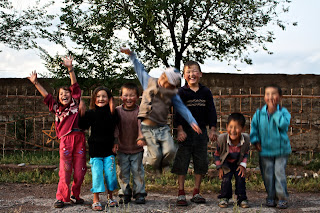
Photos: (1) Dinner, (2) Local boys, (3) Everybody jump!, (4) Little Bear, (5) Kristin and I


5.

BISHEK 

part 2

I changed benches. The previous occupant of the bench I had been on was an enthusiastic spitter and the evidence of his enthusiasm was making me nauseous. I don’t know why, but Asians spit, a lot. Look down and you’ll see white, viscous globs all over the sidewalk. Men, women, young, old, rich, poor all spit. I have felt the need to spit only a few times in my life, in Asia it seems to be as physiologically imperative as breathing.

I was in Dubovy Park, a popular spot in Bishkek with shady paths, fountains, outdoor cafes and busts of the great players in Kyrgyz history. Kyrgyz and Russian boys zipped back and forth on skateboards, yelling out challenges and trying to impress each other with their skills, just like boys the world over.

Seated next to me on the bench was Honey. She initiated a conversation, telling me that she was a shop manager and came to the park every day at lunchtime. She asked me if I had any children. No, but I had a niece and two nephews and showed her their pictures. Honey pulled out photos of her two daughters, aged three and four. The older girl had blue eyes, like her father Honey said. That turned out to be about the only thing he had given his daughter. He was a complete ass as a husband and a father.

When the younger daughter was two months old she got very sick. The doctor told Honey that the girl would never be normal, never walk or talk, and advised Honey to give her up for adoption. Honey’s husband agreed, and complained about wasting so much money on a girl.

Honey ignored both the doctor and her husband, and today the girl is fine and healthy and loves to dance.

Honey’s husband left her soon after saying he wanted boys, not girls, and he wanted nothing more to do with any of them. He remarried and his new wife was pregnant. Both Honey and I hoped that they have a girl.

I left Honey and wandered over to a wedding party that was being photographed in front of a fountain. They were a jolly group, well lubricated despite it being before noon. The bride was Russian and the groom, Korean.

There were Russian and Koreans among the revelers, but were there any Kyrgyz I asked. A young man with languid almond eyes was pointed out. He quickly refuted the claim, “ I am half Korean and half pure Tatar!”

“What is that?” I asked pointing to the bottle of coppery liquid that the groom, a large man with eyes already half-closed from alcohol, held in his meaty hand.

 “Cognac,” he replied and then asked, “Do you like it?”

“I don’t know. I’ve never tried Kyrgyz cognac.”

At that remark, Ivan, a Russian fireplug with a buzz cut, dumped out his glass and the groom filled it with cognac.

"According to Russian tradition,” the groom informed me, “the glass should be filled to the rim and downed in one go.

“I’m not Russian,” I reminded him, but threw down the (thankfully) smooth liquor in the requisite one gulp. I didn’t want to gag or choke and give away my lightweight status.

I drank the glass of pineapple juice I had been given as a chaser, thanked the group, wished the happy couple good luck, and moved on.

✢

In my twenties and early thirties, I wasn’t so much a traveler as a seeker. I wasn’t out to experience and learn about new cultures and return home. I was location scouting, looking for a home, a place where I fit in, driven by a restless longing for a life that I never figured out how to live. Every place I moved I was sure it was there that my brilliant career would begin. But I was diffident, relying too much on chance, waiting for life to discover me. Life, however, had other places to go, other people to see, people who knew how to put themselves forward and attract its attention. The problem was that I wasn’t comfortable in my own skin and no country or city was going to magically change that. 

Always moving, starting over, making new friends was exhausting. In the span of twelve years I had lived in London, Palo Alto, Washington, D.C., Santa Fe, Albuquerque, Tokyo, Santiago, and Cuzco, spent several months working in a ski resort, three months in the Caribbean, a couple of months in Southeast Asia, a couple of months in France and a few more months traveling around South America.

I reached a point where I wanted to relax and not worry about where I was going to go next, and the next place after that. I chose to settle in the last place I ever thought I would be happy: Taos, New Mexico. My family started taking ski vacations there when I was twelve and my parents had moved there in 1985. I hated it as a kid, dusty and nothing to do, but I had met Mark when I was there visiting in 1998. I thought he was the home I had been searching for. I went back to Cuzco, where I had been living, bid my boyfriend there goodbye, and moved to Taos.

Mark was an architect, he had ambitions, he spoke English and he had a nice life that I saw myself being part of. For a year and a half I ignored the obvious: I was the only one in the relationship. Everything would be great for a few weeks then he would break it off only to come back a week later, a cycle that repeated itself numerous times. I thought he was scared, having recently come out of a four-year relationship when we met.

When he left me for another woman I was devastated, but instead of running away I stood still and tried to figure out what had happened. I had wanted to feel settled, to feel that I belonged somewhere and to someone, and I had wanted it right away. Mark had been a means to those ends. I had convinced myself that Mark was the man I was looking for rather than being the type of man I wanted. I realized that I wasn’t in love with him, there were some things about him that really irritated me, and he turned out to be a coward, not telling me himself about the other woman but letting two of my friends do it. I was grateful to him for leaving me. I turned my attention to what kind of life I wanted to live and to make it happen. I had opened my shop six months after my arrival and that gave me some freedom – meaning that I must have been doing something wrong because it seems most shop owners are tied tightly to their businesses – especially when I joined forces with Michelle who began as a friend, became an employee and eventually my partner in a unique business partnership.

Then I really started traveling, usually alone. I wasn’t running away. I wasn’t looking for a home; I had friends and a home to come back to. I went to Tibet, Turkey, Cuba, Inner Mongolia, Spain, Morocco, Laos, Bhutan, Czech Republic.

I am a good traveler. I can figure out exchange rates and subway maps. I can handle long bus and train rides. I am open to other cultures and ways of life. I never make negative comparisons of other countries to the United States. I am not afraid to eat something, even when I’m not sure what it is (except for the fried chicken feet and the pond scum I was offered in Laos).

But for all my travels, I have never mastered packing. I never pack the right clothes or shoes. I always end up looking frumpy or dumpy; my look cannot even aspire to be described as “backpacker chic.” I see other women travelers in cute, wrinkle-free skirts and dresses and I wonder how they do it and how do I, who dress fashionably at home, fail so miserably at being stylish when abroad?